Publication in Nature communications awarded “Paper of the Month”

By |2025-08-25T17:01:58+02:0025.08.2025|

New CRC publication in Nature communications: Lineage-specific microbial protein prediction enables large-scale exploration of protein ecology within the human gut A recent publication in the prestigious journal Nature Communications has been selected as “Paper of the Month” by the committee at Aachen University Hospital. The lead author of the paper is our [...]

New CRC publication in Nature Biotechnology

By |2025-05-26T12:25:51+02:0023.05.2025|

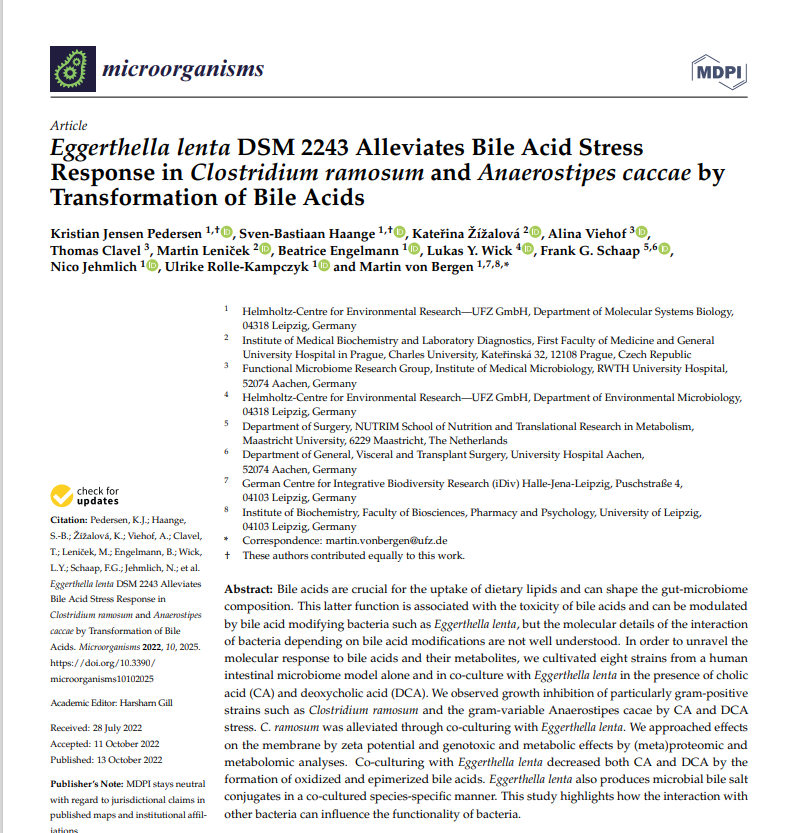
New CRC publication in Nature Biotechnology: Next-generation anaerobic cultivation CRC1382 scientists Thomas Clavel (projects A05 and Q02) and Maria Vehreschild (project B07) and colleagues share their thoughts on future developments of anaerobic cultivation methods for microbiome research and innovations, including personalized organ-crosstalk investigation. https://doi.org/10.1038/s41586-025-08885-4

New CRC publication in Nature

By |2025-04-28T11:27:28+02:0028.04.2025|

New CRC publication in Nature: Deep Visual Proteomics maps proteotoxicity in a genetic liver disease Alpha1-antitrypsin deficiency arises due to mutations in alpha1-antitrypsin (AAT) leading to AAT misfolding, hepatic accumulation and consecutive hepatotoxic stress. To improve our understanding of proteotoxicity, Rosenberger et al including Pavel Strnad (A03) employed a novel proteomic technique [...]

New CRC publication in Gut

By |2025-04-11T11:30:26+02:0011.04.2025|

New CRC publication in Gut: Reactive cholangiocyte-derived ORM2 drives a pathogenic modulation of the injured biliary niche through macrophage reprogramming In this study, the CRC1382 team working on project B05, revealed the roles of the cholangiocyte-derived ORM2 protein in re-shaping the portal niche during liver diseases. Cholangiocytes are epithelial cells lining the [...]

New CRC publication in Liver International

By |2025-01-09T10:22:39+01:0009.01.2025|

New CRC publication in Liver International: Alpha-1 Antitrypsin Inclusions Sequester GRP78 in a Bile Acid-Inducible Manner Alpha-1 antitrypsin deficiency (AATD) is a rare genetic disorder that results in the accumulation of misfolded AAT protein in liver cells, causing chronic liver injury. Principal investigators (PIs) Prof. Pavel Strnad and Dr. Nurdan Guldiken from [...]

New CRC publication in PNAS

By |2025-01-09T09:39:43+01:0009.01.2025|

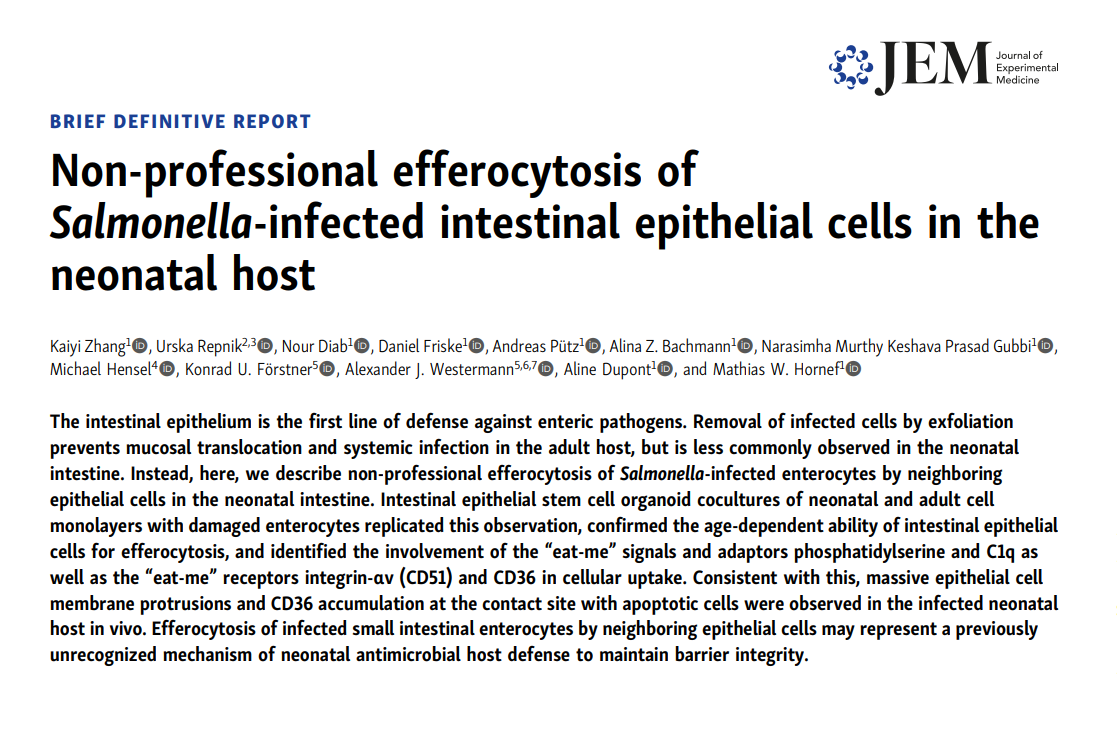
New CRC publication in PNAS: Salmonella infection accelerates postnatal maturation of the intestinal epithelium The postnatal establishment of metabolic, host–microbial, and immune homeostasis is the result of precisely timed and tightly regulated developmental and adaptive processes. Tissue damage during this “neonatal window of opportunity” may disrupt these processes explaining human epidemiological data associating [...]

New CRC publication in Liver International

By |2024-08-08T09:57:55+02:0008.08.2024|

New CRC publication in Liver International: Using machine learning and big data to understand the gut liver axis Metabolic dysfunction-associated steatotic liver disease (MASLD) affects approximately one third of the population and can progress to much more severe states of liver damage influenced by the interplay of lifestyle, genes and environment. One [...]

New CRC publication in Advanced Science

By |2024-08-08T09:52:24+02:0009.07.2024|

New CRC publication in Advanced Science: Dissecting Acute Drug-Induced Hepatotoxicity and Therapeutic Responses of Steatotic Liver Disease Using Primary Mouse Liver and Blood Cells in a Liver-On-A-Chip Model Metabolic dysfunction-associated steatotic liver disease (MASLD) is a chronic liver disease affecting more than one quarter of humankind. This study by Adrien Guillot, Frank [...]

Addressing the function of microbially conjugated bile salts in human bile

By |2024-08-06T12:04:33+02:0025.03.2024|

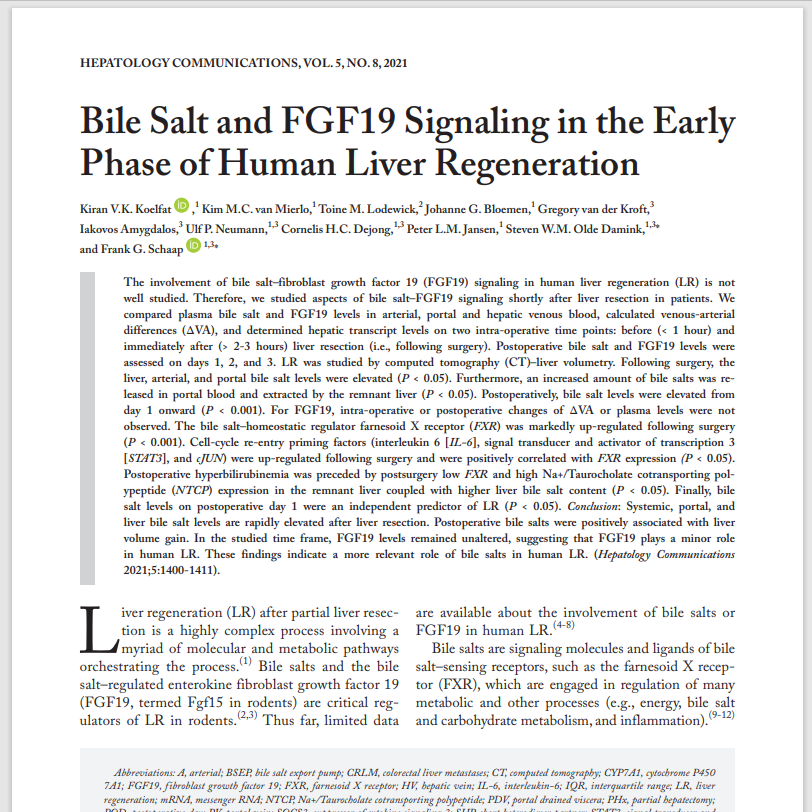
Publication in Hepatology Communications Microbially conjugated bile salts found in human bile activate the bile salt receptors TGR5 and FXR   Bile salts are an important means of communication in the organ crosstalk between gut and liver. PhD student Ümran Ay, Frank Schaap, Steven Olde Damink [...]

Go to Top