Boosting Biodata Bootcamp
The NFDI4Microbiota hosted its Annual Conference from 15–17 September 2026 at RWTH Aachen University.
The CRC1382 was represented at the conference by the data steward Catherine Gonzalez as well as the Technical training and consulting team lead, Dr. Lukas C. Bossert, from the RWTH IT Center Research Data Management Department. The aim of conference was to train the biological research community in research data management and data analysis, while providing inspiring insights into how these skills contribute to high-quality scientific research.
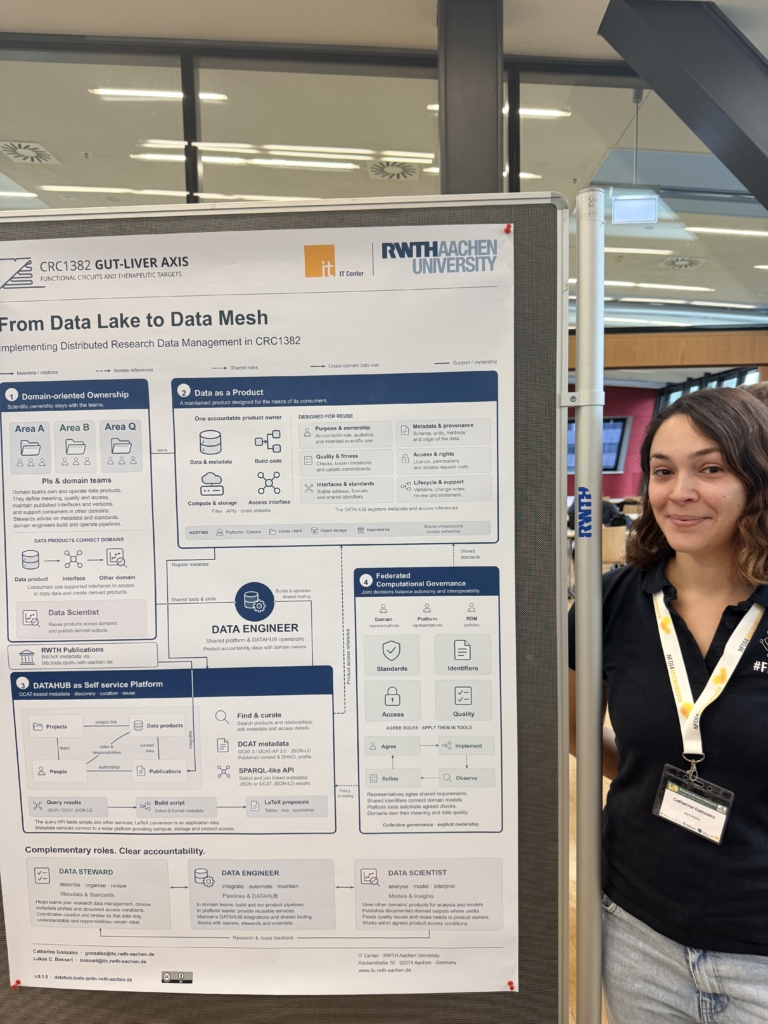
RDM Future Plans
During the second funding period the direction of research data management (RDM) has moved from a data lake approach to a structured data mesh concept by establishing a DATAHUB as a core feature. To learn more about these infrastructure concepts take a look at our RDM Newsletter 19.
What is the DATAHUB?
The DATAHUB is a lightweight portal for making research data products visible, searchable, and curatable across a distributed research environment. It does not replace the actual data repositories. Instead, it acts as a metadata and relationship layer above them. Data products remain in their domain- specific storage locations, such as Coscine project spaces, publication repositories, imaging resources, omics archives, or internal staging areas. The hub collects the descriptive metadata, ownership information, project links, publication links, access status, and readiness indicators into one browsable interface. This fits the data mesh approach because responsibility for data remains close to the research domains, while the hub provides central discoverability and governance.
The DATAHUB
The DATAHUB displays cards for projects, people, and datasets. Each card is completed with metadata:
- A name
- Registry ID
- Description
- Status
- Access model
- Responsible people
- Related projects
- Publications
- Standards, metadata profile
- Links to external systems
Data Products
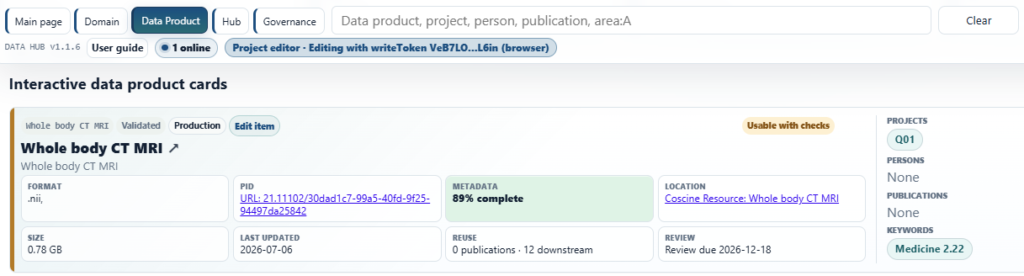
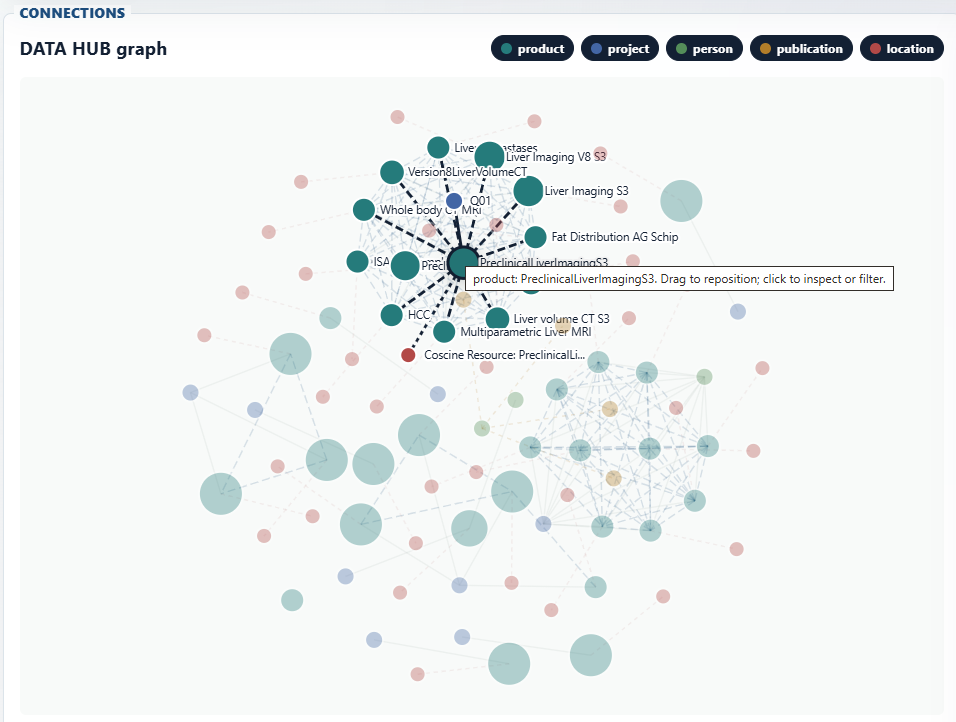
The app makes these relationships visible through search, detail views, coverage matrices, readiness panels, and a knowledge graph. In this sense, the hub is not a monolithic data warehouse, but a coordination layer for a federated data landscape.
Users can
- Browse projects, people, publications, and data products
- Search across all metadata
- Inspect relationships between entities
- Review governance signals such as missing metadata, stale records, access readiness, reuse potential, and coverage gaps
- With a valid write token, authorized curators can edit metadata and relationships, project-level settings, branding, feature flags, BibTeX sources, and data dumps.
- Admin users can create projects and download the SQLite backend database for backup or transfer
Knowledge Graph